Information for the Accountant
The deadline for submitting financial statements is August 1 of each calendar year. Please feel free to submit them earlier; we typically begin our review in June, so it would be helpful if as many of you as possible could submit your financial statements as soon as they have been approved.
The following must be submitted to Charity Monitoring Norway (IK):
- Revised activity-based financial statements with a signed balance sheet and notes
- Signed Annual Report
- Signed Auditor’s Report
- Auditor’s Report
- Self-Assessment
Charity Monitoring Norway has created an accounting template for an activity statement and balance sheet that can be used as a guide when preparing the official financial statements.
Download the form:
Budget form in Excel
Auditor’s report in PDF
Accounting Requirements for Organizations Approved by the Fundraising Oversight Authority
Approved organizations must prepare financial statements in accordance with the Accounting Act and NRS(f) Generally Accepted Accounting Principles for Nonprofit Organizations.
The official financial statements must be prepared using an activity-based presentation format. Approved fundraising organizations subject to consolidated financial reporting requirements must also prepare consolidated financial statements based on the activity model.
Note: Charity Monitoring Norway requires that Approved Organizations list “Fundraising Expenses” on a separate line under “Fundraising Costs” in their financial statements.
See our guide to the layout plan here
Why use activity-based accounting?
Charity Monitoring Norway requires that an activity report be submitted because this best meets the users’ need for information. An activity report details how the funds raised have been used, and it allows users of the financial statements to verify whether the organizations are actually carrying out the activities they claim to be undertaking.
Requirements for Activity-Based Accounting
The organization is required to use an activity-based chart of accounts; this means that the official financial statements to be approved by the board must be prepared using an activity-based chart of accounts, and that these are the financial statements the auditor is to audit.
It is not sufficient to simply enter some figures into the Fundraising Control’s template for activity reports as an attachment to the official financial statements.
Why is it important to discuss cost allocation?
It is important that costs be allocated in a reasonable, reliable, and consistent manner, as this affects the allocation of costs among the various organizational activities and the calculation of key figures: the fundraising percentage, the program percentage, and the administrative percentage. Describing how costs are allocated also makes it easier for financial statement users to assess the cost structure of the various organizations.
Requirements for the Allocation of Costs
The Fundraising Control guidelines require that a note be included explaining the principles and assessments used as the basis for allocating costs among the various activities. If the organization is so small that each activity incurs only direct costs, this must be disclosed. The allocation principles must be adequately documented and endorsed by the organization’s management and governing bodies.
Example of Cost Allocation
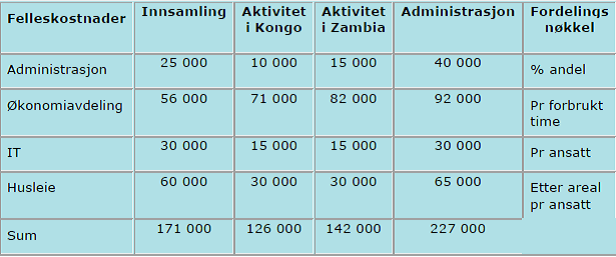
Direct costs are allocated to the activity to which they pertain, including salaries, travel, etc. In this example, this is based on the requirement that employees keep timesheets so that costs are allocated in a reasonable, reliable, and consistent manner. Overhead costs are allocated according to the table below:
Why a policy statement?
It is important to disclose the accounting principles used in the preparation of the financial statements so that users of the financial statements can see how various items have been treated in the financial statements.
Contents of the Policy Statement
The policy statement should include at least the following points:
- The accounting standards under which the financial statements were prepared (the Norwegian Accounting Act and Generally Accepted Accounting Principles for Nonprofit Organizations)
- The accounting standards under which the financial statements were prepared (the Norwegian Accounting Act and Generally Accepted Accounting Principles for Nonprofit Organizations)
- General Rule for the Valuation and Classification of Assets and Liabilities
- A description of the accounting principles for the various balance sheet items
- Revenue Recognition Principles—including the treatment of (if applicable):
- Membership Revenue
- Grants with or without repayment terms
- Gifts and Fundraising
- Inheritance
- “Sponsorship Revenue”
- Sales
- Lottery revenue
- Other Revenue
- Principles for the accrual of expenses, including the allocation of expenses, with reference, if applicable, to a note providing further details
- Consolidation principles, if any
- Accounting Treatment of Pensions (if applicable)
- Principles for the Treatment of Foreign Currency
- Change in Accounting Policy and Comparative Figures
- Other Special Circumstances
Types of Restricted Capital in the Activity Statement
- Initial Capital (for Foundations)
- Designated capital subject to externally imposed restrictions
- Designated capital subject to internally imposed restrictions
- Other Special-Purpose Capital
Why a purpose-specific capital note?
Under Norwegian accounting law, all entries must be recorded in the income statement, with a few exceptions. When using designated capital, expenses must be recorded in the activity statement and not directly against the designated capital. A restricted capital note shows which items have been recorded directly against the restricted capital. Another (not to be highlighted or underlined) purpose of the restricted capital note is to provide an overview of the various types of restrictions that exist and how the organization complies with them.
Requirements for the Restricted Capital Note
Information must be provided regarding the main types of restrictions in place and how the organization complies with them, as well as any changes during the year. If funds have been both added to and used from the various designated capital lines subject to external and internal restrictions, these amounts must be reported on a gross basis either in a note (recommended) or in the final section of the statement of activities.
Example of a Note on Restricted Capital
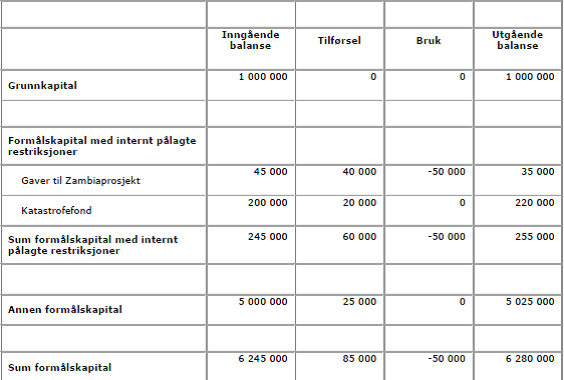
In 2010, the organization received a substantial bequest. The board decided that this bequest should be recorded as restricted endowment funds with internally imposed restrictions. The testator’s heirs have continued to contribute funds to the same project. These funds are restricted until they are actually used in Zambia.
The Board has decided that 10% of any positive operating income, with a minimum of NOK 20,000 per year, shall be allocated to the disaster fund. The funds may only be used in connection with major disasters, and their use must be approved by the Board.
What is a related party?
A relationship between two parties may be classified as a related-party relationship if one party can influence the other party’s decisions. The ability to influence another party is normally achieved through ownership, participation in the entity’s decision-making bodies and management, or through contractual relationships. The degree of influence may vary.
Why Disclose Related Parties
The Fundraising Oversight Authority requires that related parties be disclosed so that it is possible to determine whether anyone has the potential to influence the organization. Such information will make it possible to view the organization’s activities in the context of, for example, corporations owned by the organization that may operate part of the organization’s business, as well as other affiliated subsidiaries, in order to see the organization’s entire range of activities in context.
Disclosure Requirements Regarding Related Parties
The organization must disclose which related parties it has as subsidiaries, organizational units, and affiliated organizational units abroad. In addition, information must be provided regarding significant transactions with related parties and receivables/liabilities owed to them as of the end of the fiscal year.
If there are no related parties, this should be disclosed in a note. (In the same way that one discloses that one has no employees.)
Calculation of Key Figures
The data collection guidelines require that the following information be disclosed in a note:
- Disclose in a note the collection rate for the last 5 fiscal years
- Disclose in a note the percentage of funds allocated for specific purposes for the last 5 fiscal years
- Disclose in a note the administrative expense ratio for the last 5 fiscal years
For calculating percentages, see section 4.3.2 of the guidelines.
In order to calculate the fundraising percentage, funds raised must be broken down so that fundraising costs are reported on a separate line in the activity statement.
NRS (F) Generally Accepted Accounting Principles for Nonprofit Organizations also require that verbal explanations be provided in the notes regarding changes in the percentage figures.
One such explanation could be, for example: “The fundraising rate has decreased compared to last year because the organization has focused on increasing the number of regular donors, which will lead to higher revenue for several years to come.”
Charity Monitoring Norway has created an accounting template for the statement of activities and balance sheet that can be used as a guide for preparing the official financial statements.
Good Examples
The “Approved” list contains the financial statements of all approved organizations. You can get ideas by seeing how other organizations have prepared their financial statements. See the list below for examples of financial statements from both large and small organizations that are worth a look:
Norwegian Red Cross
The Cancer Society
Doctors Without Borders
ADRA Norway
Children at Risk Foundation (CARF)
Project Haiti
Do you have any other questions?
Contact us!